Tuesday, August 24, 2010

In Between Stays Part I

Last week Thursday we finally arrived at the Mwamba Field Study Centre in Watamu on the coast of Kenya after a marathon journey starting at Tuesday 6 am in Edinburgh and ending at 4 pm two days later.
 
Saying goodbye to the Surrey Field Study Centre was one of the hardest things we have ever had to do. Anna and I went for a final tour around the property to farewell our 'home' for the final time. Almost everyone got up early to see us off before Matt, Roxy and Abigail drove us to the airport. I still get sad remembering that morning. But alas, it was time to go onto other adventures.

Our first destination was New York City to visit Melissa, an old flatmate of Anna's, and her growing family (their 3rd child was born just one week after we left). We flew into Toronto, headed straight into town and caught an overnight bus to New York. Sadly, in my confused semi-asleep state, I left my Hawaii cap behind on the bus :(.

We couldn't have hoped for a better way to recover from leaving the centre. We had heaps of time just relaxing around their house and looking after Natalie and Abel and talking church and theology. The timing of our visit could not have been better, with our hosts having been invited to dinner at Ben and Franci Hoyt's new pad in Brooklyn. We arrived at their place - it looked like we had entered the set of Seasame Street. I was wary of any lurking trash cans. It was great to catch up with some more friends from home and to have the rare opportunity to speak Kiwi. On Monday, Melissa's husband Nathan (the pastor of a Hispanic church plant) took us into the big apple to see the sites including: the Statue of Liberty (from a distance), the golden 'calf', Wall St, a huge book store and the highlight - Central Park. That apple is big indeed. Is it sad to say that my highlight of the New York trip was visiting Queens County Farm Museum with Abel and Natalie? It reminded me so much of home back in Canada.

 Dinner at the Hoyt's
Central Park
Miss Liberty
Natalie checking out the sunflowers at the farm museum
After 4 days we farewelled the Ketchen's and headed back to Toronto by bus to stay with Paul and Jenny Abell and their daughter Victoria, whom we met at the A Rocha team retreat. It was great to catch up with them and see some of the A Rocha work Paul is involved in. We helped at one of the weekly(!) stewardship events he leads at Warden Woods, pulling out invasive weeds that were beginning to smother recently planted trees. They were super great hosts, giving up their bed for us and then even lending us their car!
 Walking along Lake Ontario, pre-swim.
We cruised down to St Catherines for a few days, staying with the Stares. More chilling out ensued, punctuated with trips to the Niagara Falls, Fort George (with demonstration musket shows) and a walk up to Ball's Falls. The Stares are super tour guides. On the first night at St Catherine, we headed out to Lake Ontario to watch the sunset. Right on the lake front is a restored carousel (merry-go round) that was donated to the region on the condition they keep the price at 5c. This was my chance to finally ride the classic fair fare and ride we did.
Sunset on Lake Ontario with a silhouette of Toronto
Niagara Falls
Table rock on the way to Ball's Falls
 Al, Lydia, Rebecca and Anna at Ball's Fall
From St Catherines we headed back to Toronto via Hamilton, where we stopped to have lunch with Christina, a tutor from Anna's teaching college. We returned the car and farewell the Abells one last time.

It was really special to be able to spend so much time visiting with friends in the East and a fitting way to finish our time in North America.

Monday, August 2, 2010

The Halfway Holler

Greetings one and all!

So here we are, having just completed our 6 month stay at the A Rocha Canada's Surrey Field Study Centre and soon to begin our 6 month stay at the Mwamba Field Study Centre in Kenya. We thought now would be a good time to update you all on some of our work and adventures and a little of what we’ve been learning along the way.


We arrived in Vancouver on the 2nd of February just a few weeks before the Olympics kicked off. It was thrilling to finally begin our big OE year and it didn’t take long for us to feel totally at home at the centre in White Rock, Surrey; about a 45 minute drive from the city, and a 10 minute walk to the beach and US border. We quickly came to love the lifestyle at the centre – beautiful grounds with large vege gardens, free range chickens, ponds, a small forest and even resident Highland cows. We enjoyed the weekly rhythm of the place too – Tuesday to Saturday work week, daily prayers, shared meals, weekly bible studies and music times to keep working on the guitar skills.

The challenge of the first month or so was working out exactly how we would be involved. Volunteers usually choose one field to work on – conservation science, education or agriculture. The natural choice for Lynton was conservation science but we arrived in winter, at the quietest time of year for the centre, and had to wait for spring before any science projects could begin. Glad for the break from teaching, I was reluctant to become fully occupied with the education field so it took some time to work out where I could participate.

This period of uncertainty provided a good opportunity to reflect on the hectic time schedules we used to have back at home with work, commuting, youth work, committee meetings, and more work. It was so refreshing to be in a place where work did not define and absorb us completely, and to remember that our worth is not measured by how productive we can be.

And before long we both ended up with plenty to work on! As we waited for spring, Lynton got stuck into removing invasive weeds from the property. Then together (and with the help of another volunteer Stan) we began a frog survey. For the month of March we took one day a week to walk around 16 ponds on 7 different sites all found in the Little Campbell River watershed. We were repeating a survey conducted by a science intern the year before which involved slowly walking around each pond looking for egg masses from the threatened Northern Red Legged Frog and also recording sightings of some other salamander and frog species. Lynton completed the project by writing up a report of the findings as well as sending a letter to pond owners with information about how they can enhance the habitat on their land for Northern Red Legged Frogs.

For the remainder of our time, I was occupied with a number of projects. In April as the weather got warmer, school groups began to visit a couple times a week and I would help lead them. The programs were typically geared for hands on encounters with nature – pond dippings, collecting eggs, looking for bugs, birds and frogs etc. For many city children, going to the centre is a rare opportunity to get out into the outdoors and see creatures they might otherwise never see. It was great to see their excitement when seeing a rough skinned newt or bald eagle or Highland cow (or worm!) for the first time.

I also had the privilege of being able to spend a lot of time producing some art work for the centre. There are a couple dozen chickens onsite and when we came most of us could not identify the names of the different breeds. I painted a series of acrylic paintings of 7 different chickens. These paintings now hang at Brooksdale Farm (the new site that A Rocha Canada is moving to later this year) in rooms that will likely be used for guest accommodations. I also made some posters and flashcards for educational purposes so we could learn the names of the different breeds. The paintings have recently been used to make gift cards to be sold in the store on site as well. That project was quickly followed by another – painting about 40 signs for the vegetable garden.

Some of Lynton’s time was spent organising the creation of a preliminary biological inventory of Brooksdale Farm. He held a bioblitz at the farm with 15 volunteers identifying over 190 species during the course of 6 hours. The data collected will assist the development of a well-informed management plan that will enhance and nurture life at Brooksdale. Lynton also put his science skills to work in supervising the conservation science interns that arrived for the summer. Halfway through our stay, Lynton was given the opportunity to attend the 2010 Pastor's conference at Regent College on Science and Faith. Regent College graciously gave him a scholarship to help cover a lot of the conference fee and allowed me to attend one day of the conference for free. He thoroughly enjoyed the theological stimulation and excellent bookstore housed on campus (Anne-Marie’s short but action packed visit provided him with a way to get all his new books home).

It certainly wasn’t all work and no play for us though – in June we had the opportunity to hire a car and travel around BC for a week. We spent the first couple of days staying at a holiday home belonging to a family of the one of the staff at A Rocha. Then we headed east into a desert area called the Okanagan.  There we stayed with a former intern from the centre who now works in a Rattle Snake Recovery program. She took us out to hunt for the snakes with a quick safety briefing (look out for falling rocks, poison ivy, and hidden snakes.) Using a radio telemetry receiver, we managed to find a couple transmitter-tagged rattle
snakes hidden under piles of rocks.

The next day we headed north up to the Rockies. It was great being able to drive into campsites and pitch our tents in spots with stunning views of the mountains. We were keen to do a 2 night hike but it was pretty early in the season and most back country sites were still closed due to snow. But we managed to find a hike that was open in Banff National Park. A 5½ hour walk took us into a simple campsite next to a frozen lake. We had to spend a fair bit of time hanging out in the tent trying to keep dry, and we were very diligent to keep our campsite free of bear-attracting food scraps. All our food could be hung in bags high up in the trees that were hauled up by a pulley system. The views and wildlife we loved, Camping in Yoho National Park the threat of bears and lack of camping huts made me miss NZ hiking. Then we finished our holiday by heading to Banff, a tourist mecca just inside the state of Alberta. The hotel, the roof top spa, the specialty shops were all welcome luxuries after roughing it in a tent, so it was a good way to end the holiday before making the 10 hour drive back to the centre the following day.
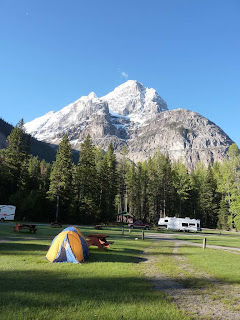
 Camping at Yoho National Park

Over the 6 months we observed the field study centre being a place of learning about God's creation and His care for it - for school kids through to adults, a place of healing for broken people and a life giving place through good food, faith and fellowship.

We come away from our time at the centre greatly enriched. One area in particular is our relationship to food. Living on an organic, sustainable farm, watching documentaries and enjoying table fellowship have all challenged our view of food. We have come away with a greater appreciation of God's role as provider, greater respect for lives of the creatures that feed us and realisation that food is more than just nutrients. It holds the power to draw us to thankfulness, to create community and provide much joy and celebration rather than distancing us from creation and damaging ourselves and the earth as so much 'food' does today. Our experiences of living more simply and in community have also shaped us for how we want to live in the future.

We have a few weeks now on the other side of the continent visiting friends in Toronto and New York before heading to Kenya via the UK. We are very thankful to God for all that we experienced in Canada and look forward to moving to the whole new world that is Africa.

Because of Him,

Anna and Lynton Baird

PS. You can follow us at our blog and see photos of the trip on flickr:
http://www.lyntonandanna.blogspot.com/
http://www.flickr.com/photos/lyntonandanna

Sunday, July 25, 2010

Anna's Top 10

Lynton's post has inspired me to do the same ...
Anna's top memories/experiences from A Rocha Canada time in no particular order:
  • The Painting - I've never had so much time to dedicate to my hobby of painting.  From teaching art lessons, to getting art lessons, to painting chickens and vege signs ...
  • The Animals - the humming birds, woodpeckers, bald eagles, coyotes, raccoons, elks, rattlesnakes, frogs, the list could go on
  • The Cooking - making homemade pasta, curry, muesli, pizza, naan, yoghurt etc = good times
  • Not Teaching! - ahh the freedom, ahh the stress-free life of not being a full time teacher
  • The Rockies - the best camping spots, the grandest views, the coolest animals
  • The Sister-in-Law visit - Anne-Marie came bearing gin and chocolate and an empty suitcase to send all Lynton's newly acquired books home, fun times were had, Colin was christened Coco-pops 
  • The Guitar Playing and Singing - weekly, multi-hour singalongs with the best harmonies and some of my favourite songs
  • The Learning - biblestudies, documentaries, books, and conversations to expand the mind
  • The People - they'll be remembered long after all the other memories fade
  • The Time and Space - to think, to read, to pray, to paint, to chat, to learn, to love
Grateful.

Lynton's Top Ten Highlights at A Rocha Canada

Here they are in no specific order:
  • the Field Study Centre - it's like living on a farm/nature reserve. The most peaceful and life-giving place I have ever lived at.
  • the people - I could have never wished to spend 6 months with a better bunch. We have come away with many friends that I think will go the distance - miss you all heaps
  • the food - what could be better than eating fresh veges straight out of the garden, collecting eggs from under the chickens and ocassionally savouring beef from a cow that grazed the fields. I gained a greater appreciation of our reliance on the Lord of the Harvest for all his wonderful edible creations.
  • cooking - I enjoyed the challenge of cooking for groups ranging from 4 right-up-to 86 people, sometimes using ingredients I had never heard of before. Life at the centre allowed enough time for you to put love into the meal.
  • curling - has there ever been such an exciting, tense, tactical and beautiful winter sport played on ice without skates? After studying the curling during the winter olympics I got two chances to learn how to play. Man that was fun!!! My final stone landed right on the edge of the button.Yeesssss!
  • the boat maintanence weekend - a large team of A Rocha folk descended on the Hunterston Farm on Galiano Island to clean, strip and paint two replica long boats of the Captain Cook era that are used in educational boat trips. The time was capped off with a two hour row/sail in the El Nina (?)
  • the birds - After making many jokes about my former supervisor's fascination with birds, I would have never imagined that I myself might assume the title 'birder.' However, Colin and Stan's passion for birds slowly rubbed off on me to the point where I learnt a handful of bird songs and I would SOMETIMES take binoculars out with me on a walk. It did help that many of the of Canadian birds liked our bird feeders and that they have Woody the woodpecker, bald eagles and hummingbirds!
  • all the other animals - New Zealand has great wildlife but due to being separated from other land for so long it missed out on many cool creatures. We have seen coyotes, elk, 5 species of squirrel, lots of amphibians, garter snakes and hoary marmots - to name just a few. I also fell in love with the chickens (particularly Brahma who I saved from hypothermia) and the Highland cows, Shaggy and the late Curly, that lived at the centre.
  • games, games, games - we spent many evenings (especially in the winter) playing lots of games. From up-and-down the river, Mennonite madness, scrabble, risk and chess to soccer, basketball, table tennis and cricket (yes, cricket! I made a cricket set, complete with bails, just like my dad did all those years ago. It was a hit amongst the kids and adults alike).
  • the faith - it was such a blessing to work and live in a Christians community. We all came from  different backgrounds (Catholic, Reformed, Baptist, Mennonite....) with the same passion to  serve the Lord. I loved the formal and informal theological discussions (on creation, food, image of God, eschatology...), morning prayers, epilogues, the Pastor's conference at Regent College, Imago Dei, Southpoint (our church home for the 6 months) and pastoral care.
In short I loved it!

Friday, July 16, 2010

Video Tour of A Rocha Canada Field Study Centre

This morning we say goodbye to the Field Study Centre in Surrey after calling it home for nearly 6 months. Last night I ran around making short videos of the site so you can get a glimpse of what the place was like. Enjoy!

The vidoes can be viewed here:
http://www.flickr.com/photos/lyntonandanna/sets/72157624374846047/

Friday, July 9, 2010

Brooksdale Bioblitz!

"We care for only what we love. We love only what we know. We truly know only what we experience."1

To properly care for a habitat or ecosystem you must know what lives there. For how can you protect creatures under threat unless you know that they are present in your realm of responsibility?

Later this year, A Rocha Canada will be taking over management of a new property in the Little Campbell River watershed called Brooksdale Farm. To assist in the development of a well-informed management plan, I, Lynton, am coordinating the creation of an inventory of all the living creatures that call Brooksdale home. On Saturday the 19th of June, I organized a 6-hour bioblitz at Brooksdale Farm. A bioblitz is an intensive (usually 24- or 48-hour) biological inventory conducted by a group of scientists and volunteers, attempting to identify and record all species of living organisms in a given area.
Kenton and Barb scouring the meadow for signs of life. The predominant grass in the meadow is Reed Canary Grass, an invasive hybrid grass that grows over 1.5 m tall and smoothers all other plants.

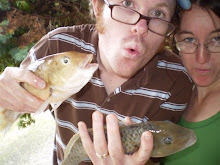
The day began with a small band of keen birders bright and early in the morning and officially kicked off with four groups of naturalists, volunteers and interns exploring the various habitats on the farm. The list of species found steadily grew over the course of the morning as the groups came back with their full data sheets. By lunch over 100 species of plants, amphibians, reptiles, birds, mammals and invertebrates had been recorded. After a bite of lunch and time scouring field guides trying to identify some elusive creatures, Stan Olson took a group dragonfly and damselfly netting; Colin Conroy took a group birding; whilst a few brave souls returned to the forest. At the end of 6 hours, the bioblitz wrapped up with more than 190 species identified. Highlights of the day included finding a common garter snake, a Western Toad, a Bullock’s Oriole, and a Pumpkinseed (fish). This successful event barely scrapped the surface of what lives on the farm, leaving the possibility for more explorations in the future.

As we build up the inventory of all the living creatures and habitats, A Rocha Canda will be better able to manage and nurture life at Brooksdale.

1 Steven Bouma-Prediger, 'For the Beauty of the Earth'

A fresh-water crayfish living in the pond, probably Pacifastacus leniusculus.
A pumpkinseed (Lepomis gibbosus) caught in the pond.
A Western Toad (Bufo boreas) on the banks of the Little Campbell river. This amphibian is a "blue-listed" species in BC, meaning that is of special concern.