Tuesday, June 15, 2010

A dozen or so of our favourite recipes

Lynton and I spend a lot of time here cooking, for numbers ranging from 2 - 80. It's been one of the highlights of our time here, not least because of the challenge or learning to cook with a pantry quite different from the one we're used to at home (think less meat, more beans/lentils). From time to time we get asked to share our recipes with others, so we're posting some of our favourites here:

Homemade Pasta
2 cups flour
3 eggs
1/4 tsp salt

Make a pile of flour on a clean bench, make a well in the centre. Sprinkle on salt. Break the eggs into the well. Beat the eggs into the flour with a fork till combined. Knead for 10 minutes. Refrigerate in a plastic bag for 20 minutes, then feed through a pasta machine. A drying rack for clothes also makes a great drying rack for pasta!

Scones 
from the classic NZ recipe book Edmonds cookbook
3 cups flour
6 tsp baking powder
1/4 tsp salt
75 gm butter
1 - 1.5 cups milk
1/2 - 1 cup cheese
optional: herbs, olives, sundried tomatoes, cumin seeds etc

Mix flour, baking powder, salt. Grate butter into flour mixture. Add olives etc if desired. (Dip in butter to prevent it melting in your hands.) Knead a few times. Roll out on floured tray. Cook for 10 - 15 minutes at 220 C.

Pasta Bean Soup  
in various Alison Holst recipe books
3 tbspn oil
1 clove garlic
2 small dried chillies
2 bay leaves
1/4 tsp thyme
400 gm can of tomatoes
2 cans kidney beans and other beans (e.g. chickpeas, pinto beans)*
4 cups of vege stock
1 cup short pasta
1 tsp salt
black pepper

optional: pesto, parmesan cheese

1. Heat oil in large pot. Add garlic, onion, cook till onion is clear.
2. Add chillies, bay leaves, thyme.
3. Add tomatoes, beans, stock. Boil till beans are tender.
4. Add pasta, boil till cooked.
5. Add salt and pepper to taste.
6. Serve with pesto, cheese, fresh herbs and crusty bread.

* can use 1 cup of dried beans instead - cover in water with a few inches of water above beans, soak overnight. Can add a tablespoon of vinegar to help soften them. May still need to be boiled for an hour or more before they are cooked.

2 cups dried beans = 6 cups cooked beans

* recipe can be adapted for 100 people. Use 20 cups of dried beans and increase other ingredients by reasonable amounts
Pizza crust Moosewood Restuarant New Classics recipe book
(aka the best pizza crust ever!)
1 tbspn yeast
1 tsp sugar 
1 1/3 cups warm water 
3 cups white flour 
1/2 cup whole wheat flour 
1 tsp salt 
1/2 tsp pepper 
3 tsp oil 

1. Stir yeast into sugar and water. Let it sit for 10 minutes till frothy.
2. Mix flour, salt, pepper and oil together. Add liquids and mix to make a dough.
3. Knead for 10 minutes. Place ball of dough in oiled bowl, cover till doubles in size about 40 - 60 minutes.
4. Then punch down and knead for a few minutes. Cut in half. Roll our. Let it rise for 15 more minutes. Add toppings. Bake 20 - 30 minutes at 180 C. 


Mum's Muesli

2 cups rolled oats (mixture of large rolled oats and instant oats)
1.5 cups coconut
1/2 cup each - wheat germ, bran, chopped nuts (e.g. peanuts, almonds, hazelnuts, brazil nuts etc) sesame seeds, pumpkin seeds, linseeds, sunflower seeds
Dried fruit (e.g. raisins, apricots, apples, cranberries, bananas etc)
1/4 cup honey (or molasses)
2/3 cup oil

Blend dry ingredients (except dried fruit) in a large roasting dish. Warm honey and oil together to combine. Pour over dry ingredients and stir to evenly mix. Cook at 180 C, turning frequently to avoid burning. Add dried fruit when cooled.

Very flexible recipe - can use whatever seeds, fruit, nuts you like. 1 batch does not last long - around here I do about 6x this recipe.

Tuscan Salad Dressing 
from Eat Fresh - Cooking Through The Seasons by Annabel Langbein

3 large handfuls of fresh herbs, chopped finely
2 cloves garlic, crushed
zest of 1 lemon, grated
1 tsp salt
3/4 cup oil

Mix all ingredients to combine. Add as much or as little oil as you like. Refrigerate. Great on any green salad.

Kiwi Classic Mayonnaise

1 can sweetened condensed milk (375gm)
1 cup malt vinegar
1 tsp dry mustard powder
1 tsp salt

Mix and chill.   

Lemon Yoghurt Cake
Lauretta Duinkerke
1.5 cups sugar
rind 2 lemons
2 large eggs
3/4 cup canola oil
1/2 tsp salt

1 cup yoghurt
1/2 cup lemon juice
2 cups flour
2 tsp baking powder

Whisk sugar, rind, eggs, oil. Add salt, yoghurt, lemon juice and mix again. Sift in flour, mix gently to combine. Pour into greased cake tin or loaf tin. Bake for 30 minutes. Leave in tin for 10 minutes.

Cornbread-Crusted Chilli
another Alison Holst recipe made famous by Mum
2 tbsp oil
2 onions
600 gm ground beef (aka mince)
1/2 - 1 tsp chilli powder
1 tsp oreganum, cumin, paprika
1 can whole tomatoes
1 can baked beans (or kidney beans)

Cornbread
50 gm melted butter
1 onion
1/2 cup sour cream
1/4 cup milk or water
1 can creamed corn
1 egg
1 cup yellow cornmeal (aka polenta)
1 tsp baking powder
1 tsp salt
1 cup grated cheese

1. Heat oil in large pan, fry onions, add meat, fry till browned.
2. Add spices and stir in tomatoes and beans. Simmer gently for 10 minutes
3. Melt butter in a big pot. Add onions and cook till clear.
4. Remove from heat, add sour cream, milk, corn, egg. Mix well with fork.
5. Stir in cornmeal, baking powder, salt, cheese. Spread over meat in dish. Bake for 30 minutes at 180 C.

Vegetarian Korma
taken straight from www.allrecipes.com, made famous by Lynton

1 1/2 tablespoons vegetable oil
1 small onion, diced
1 teaspoon minced fresh ginger root
4 cloves garlic, minced
2 potatoes, cubed
4 carrots, cubed
1 fresh jalapeno pepper, seeded and sliced
3 tablespoons ground unsalted cashews (optional)
1 (4 ounce) can chopped tomatoes
2 teaspoons salt
1 1/2 tablespoons curry powder
1 cup frozen green peas
1/2 green bell pepper, chopped
1/2 red bell pepper, chopped
1 cup heavy cream
1 bunch fresh cilantro (coriander) for garnish

Heat the oil in a skillet over medium heat. Stir in the onion, and cook until tender. Mix in ginger and garlic, and continue cooking 1 minute. Mix potatoes, carrots, jalapeno, cashews, and tomatoes. Season with salt and curry powder. Cook and stir 10 minutes, or until potatoes are tender.

Stir peas, green bell pepper, red bell pepper, and cream into the skillet. Reduce heat to low, cover, and simmer 10 minutes. Garnish with cilantro to serve.

Custard Squares
a Baird classic
1 packet of water crackers
1 cup sugar
3/4 corn flour (or corn starch if you're in North America!)
1/2 cup custard powder
5 cups milk
60 grams butter
2 egg yolks
2 tsps vanilla essence

Icing: 1 cup icing sugar, 1 tsp butter, 1 tsp vanilla essence, 1 tbsp (or more) hot water

1. Combine sugar, flour, and custard powder in saucepan or microwave. Gradually add milk whilst stirring. Add butter to the mix.
2. Stir constantly over stove or ever couple of minutes in microwave until custard boils and thickens. Simmer for three minutes, remove from heat.
3. Quickly stir in vanilla essence and beaten egg yolks. Pour over cracker base. Place crackers on top of the custard and allow to cool.
4. Ice the custard squares with vanilla icing and keep in fridge until time to serve.
5. To make icing, combine all ingredients and beat till smooth. Add as much water as needed to achieve smooth, spreadable consistency.

Naan Bread
another recipe from www.allrecipes.com

1 (.25 ounce) package active dry yeast  or 2 1/2 tsp yeast with 1 Tbs sugar
1 cup warm water
1/4 cup white sugar
3 tablespoons milk
1 egg, beaten
2 teaspoons salt
4 1/2 cups bread flour
2 tablespoons minced garlic (optional)
1/4 cup butter, melted
1/2 tsp baking soda

1. In a large bowl, dissolve yeast in warm water. Let stand about 10 minutes, until frothy. Stir in sugar, milk, egg, salt, and enough flour to make a soft dough. Knead for 6 to 8 minutes on a lightly floured surface, or until smooth. Place dough in a well oiled bowl, cover with a damp cloth, and set aside to rise. Let it rise 1 hour, until the dough has doubled in volume.
2. Punch down dough, and knead in garlic. Pinch off small handfuls of dough about the size of a golf ball. Roll into balls, and place on a tray. Cover with a towel, and allow to rise until doubled in size, about 30 minutes.
3. During the second rising, preheat grill to high heat.
4. At grill side, roll one ball of dough out into a thin circle. Lightly oil grill. Place dough on grill, and cook for 2 to 3 minutes, or until puffy and lightly browned. Brush uncooked side with butter, and turn over. Brush cooked side with butter, and cook until browned, another 2 to 4 minutes. Remove from grill, and continue the process until all the naan has been prepared.

Think that's enough recipes for now - they're making me hungry!


Friday, April 30, 2010

Poultry If You Please

Since arriving, the general interest in the chickens living on site has increased greatly.  This maybe due to the fact that I started spending many hours painting pictures of the different chickens, or it could be because they kept getting eaten by coyotes, or maybe it's because Brian a.k.a. The Chicken Guy has been coming over regularly, each time filling us with amazing chicken facts and reasons why we need more chickens, ducks or turkeys to add to the flock. 
When we first arrived there were about 30 roosters and chickens.  They lived in a coop but could also roam freely around the property and we enjoyed collecting their eggs each day.  Because no one seemed to know exactly what all the different breeds were, and because I needed a job to get busy with, I set about painting some of the different chickens, with the aim of being able to display some sort of poster to educate visitors and residents alike about these colourful characters. 
The painting job turned out to be quite involved – first I had to wander around stalking the chickens, trying to capture them on camera so that I could paint them from a computer screen.  Then it was about an 8 – 10 hour job to produce each painting.  The project has been a wonderful and rare opportunity to be able to spend so much time painting, and it has also given me a great deal more respect and understanding for these birds.  Something about learning their proper names, finding out more about their history, and really focusing on the amazing variety of size and colour and temperament of different chickens certainly has a way of making you love these birds. 
So it was a little sad when they started disappearing.  Back in April, as the weather got warmer and the coyotes presumably started getting hungrier we discovered some suspiscious looking piles of feathers scattered around the property.  Goodbye Barred Rock rooster, goodbye Buff Orpington, goodbye little Frizzle hen.  Clearly, we needed to act quickly and ensure that all the chickens were getting safely in behind closed doors each night.  
With this problem solved, the next issue became one of finding balance in the flock.  The recommended ratio of roosters to hens is about 1 to 6 and we had about 1 to 2.  This lead to rather more activity, squabbling, noise, and excitement than is healthy for a hen.  So it became necessary to make the difficult decision of which roosters to get rid of.  Thankfully, The Chicken Guy (he’s the poultry farmer who originally got the Centre set up with roosters) came around and provided us with a wealth of information about which chickens were the best breed, and which we could safely cull from the flock.
Farewell Buff Orpington
 R.I.P. Mrs Frizzle

We don’t eat very much meat here at the centre (approximately once a week), but the meat we do eat comes from sources where we know the animals have been cared for in a way that respects the animals and the environment. So we have beef in the freezer from cows that grazed here, or the occasional salmon steak that has been bought from a sustainable salmon fishery.  These roosters were also headed for our freezer, so we wanted to know what would be involved in the process.  Matt and Lynton headed off to another poultry farmer's place, and there they watched and learned what is involved in killing, de-feathering and gutting a chicken.  Though it’s somewhat ‘icky’ to have known the animals we eat before they arrive on our plate, I’ve found that it certainly makes us more aware and appreciative of what we are eating and more committed to caring for these animals while they are alive.  It’s pretty sad that for nearly all the meat I’ve consumed in my life I have had no idea about where it came from, how the animals were treated in life and in death, what sort of impact they had on the environment and what was involved in the processing of the meat before it arrived at the supermarket.   And, to quote Matt in a recent discussion on the topic, "it's certainly much easier as an eater, to remain ignorant about these facts about the life of the animals, but such ignorance leads one to take for granted the seemingly endless supply of meat from the supermarket.  Coming to know these animals and care for them on a daily basis alerts us to the cost of life which our consumption of meat requires and therefore engenders a deeper thankfulness for all of our food and a commitment to ensure it is grown and cared for in ways which reflect the love we have felt for them." I think it’s going to be a lifelong learning process to learn how to eat well; responsibly, thoughtfully and gratefully.
But back to the rooster population problem – 5 roosters were taken away and have now returned to sit in the freezer to wait for someone to dream up a recipe that finds a way to tenderise old roosters.   The existing flock is much calmer without the extra competition, and it’s good to have more room in the place for the new additions that are flowing in. 
The Chicken Guy has successfully wooed Matt into seeing the benefits of expanding our flock to include more of the best breeds of chickens, as well as some other excellent poultry birds like giant turkeys and slightly ridiculous-looking runner ducks.  A few weeks ago The Chicken Guy arrived with a dozen each of duck, Australorp chicken, and turkey eggs.  We were instructed to make a batch of homemade pasta with each kind of egg and then compare the results.  They all made very good pasta but the duck eggs were clearly superior – producing a very silky and stretchy pasta. 
Given the success of the experiment, three very large white turkeys were delivered to the centre to make a home with the chickens.  These turkeys not only provide more great eggs for us to enjoy, they also have endless entertainment value for all the school groups and volunteers that come on site.  For many of them this is their first opportunity to see turkeys up close, and being such responsive, communicative animals this has become a highlight for many of the children. 
Not only have we learned about the different kinds of breeds of chickens that we own, Brian has also given us an insight into the state of poultry breeding in North America.  Most chickens here are bred purely for their meat and egg production capabilities on a mass production scale.  Unfortunately this had lead to some imbalances.  Some turkeys bred for meat are now breed with such unnaturally large chests that it is no longer physically possible for them to mate with a hen, because they are too large.  So artificial insemination is mandatory for these animals.  There seems to be something wrong with a system that is breeding infertility into an animal.  Brian’s chickens are heritage bred chickens, and he controls the breeding process to ensure that beauty, health, temperament, and size are all kept to the highest standard.  Heritage bred birds typically grow to be 3 or 4 sizes larger than the factory breeds.  
It has been great to discover that we have some rare and special chickens within our flock.  The bluebrown leghorn hen has German heritage and is possibly the only chicken of this breed in North America.  Our largest chicken, the Australorp rooster, is a grand black bird with iridescent green feathers.  This chicken’s claim to fame is that its mother won a 2008 National title in the annual chicken competition.  With the help of Brian, we will keep breeding Australorp hens here, with some of the best of his flock being used as a base. 
The Grand Australorp Rooster
                                            The Rare Blue Brown Leghorn
The latest update in the chicken story arrived yesterday in a cardboard box.  6 Australorp chicks and 3 runner ducks are now chirping away sweetly in the room next door.  The runner ducks are another bird that have comic value as much as anything else.  They are  very skinny, upright birds that run around at high speeds.  Brian tells us they are excellent slug removers and because they are herdable we can use them to walk through the vegetable garden to eat all the slugs as they walk through. 
To conclude the painting part of the story, seven chickens have now been painted, framed and hung up in rooms of the house at Brooksdale, a 2nd site that is now managed by the folks here.  These rooms will be used for guest accomodation and will perhaps be named with regard to the chicken that each room hosts, e.g. The Brahma Room, or the Rhode Island Red Room.  With scanned images of each painting, there are further opportunities to make educational posters and resources, and greeting cards to be sold at the store here at the centre.  
                                             Light Brown Leghorn Rooster
So it's come as a welcome surprise to find that there could be so much to learn and enjoy from the humble chicken.     


Tuesday, April 6, 2010

Victoria..the Queen and all that.

Several weeks ago Anna and I had a weekend away in Victoria (after the Queen). Victoria is to Vancouver in BC, as Wellington is to Auckland in NZ. What it lacks in volume, it makes up in beauty. Victoria is the largest city on Vancouver Island with a population of about 330,000. To get there you must either fly or go by boat. It just so happened that Matt and Roxy were also headed there for a wedding, so we could journey with them on the way there. We decided to take bikes with us to give us some mobility and allow us to cruise along the coastal roads. The ferry ride takes about 2 hours, winding its way between islands. It is very reminscient of the Marlborough Sounds section of the interisland ferries in NZ. We caught the 5.00 pm Friday ferry, giving us sweet views and silhouettes as the sun set behind the islands. Once docked, we farewelled Matt and Roxy. The ferry terminal is actually about 40 minutes drive from the city. To our rescue came buses, which in the Vancouver region can carry up to two bikes on their front for free! If only NZ would follow suite. I had managed to get a sweet deal on hotel accomodation with a 3 nights for 2 option plus free breaky (mmmm... bagels with cream cheese and jam). And as if that was not enough, there was a bottle store just next door, showcasing an impressive collection of boutique beers! I settled for a hoppy one called Naughty Hildegard’s Extra Special Bitter and Three Beavers Imperial Red Ale, both very tasty.


Matt and Roxy

Saturday morning began quietly, with us out wandering by 11 am. Saturday was gorgeous; blue skies and warm sunrays. We walked towards the waterfront and serendipitously bumped into the Paralympic Torch relay. It was much more low key than the Olympic one, but there was still a buzz in the air.
It turned out that we had chosen the perfect weekend to visit. Victoria was having a 'be a tourist in your own town' promotion. So for $20, Anna and I could visit many of the sites for free or half price. We began at the Pacific Undersea Garden, which was little more than a lower grade Kelly Tarltons. However, they did have a cool show with a diver feeding the fish and parading before us many of the creatures that live under the waves. From there we crossed the road to the wax museum. Before getting this tourist package we had ruled out wasting our money on such an enterprise. To our surprise it was actually enjoyable and educational. I would say that only about 1/4 looked anything like owners (though Anna rated them a little higher). And oh yeah, NZ represent, with ol' Sir Ed.

The torch                                                      Sir Ed

Our whirlwind visit of the Royal BC Museum was most informative, albeit exhausting. After 1.5 hours of racing around exhibits reading the small little plaques, your brain numbs and little is actually absorbed. The highlights were the natural history sections which had the best set designs I have seen in a museum and the exhibits about the First Nations peoples, the aboriginal peoples of Canada. From my brief exposure to their history it seems to me that there is considerable overlap between their treatment by European settlers and that of the Maori. However, it seems that Canada's oppressive policies toward First Nations peoples went much further than NZ's (more like Australia's) and the process of redressing the wrongs is in a much earlier stage than back home.
The final touristy destination was the Victoria Butterfly Gardens. We decided to put our bikes to use and get some exercise. The butterflies were further away than anticipated, with us arriving after 1.5 hours cycling through the countryside. The butterflies were pretty but fewer in number than expected (there were a lot more in the Dunedin Museum). After spending sometime soaking up the beauty and moisture, we went to catch a bus. We cut it too fine and missed it. So rather than hang around at the bus stop for the next hour, we popped back into the jungle to read our books.


The amazing atlas moth - largest moths in the world with a wingspan of 25-30 cm

On Sunday we selected to worship at the Christ Community Church, a CRCNA church. It was nice to visit a Reformy church for some familiarity and also to see how Reformies do church over here.

The T Rex trees outside of the Empress Hotel
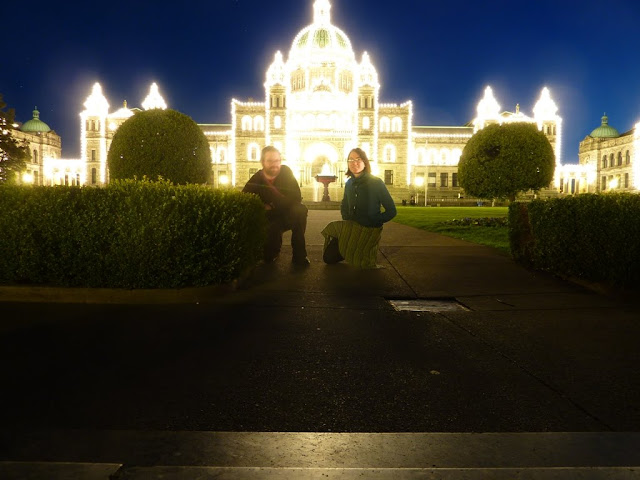
Victoria waterfront by night

On Monday we decided to go for a bike ride around the waterfront. It was a pity that the sunshine of Saturday had been exchanged with cold winds and threats of rain. Along the way we had a quick detour tour of the BC parliament. Canada has both provincial parliaments and a federal one. This grand building was designed by an architect who lied about his age, credentials and experience. He did a good job never-the-less. As BC was a colony of the Crown they required approval from the motherland for their coat of arms. However, poor communication between the colony and the Crown resulted in the proposed coat of arms being incorporated into the building - carved in stone on the face of the parliament, carved in wood behind the speakers chair, made into a large stainglass window, and cast onto hundreds of street lamps surrounding the parliament - only to have that design rejected by the Crown. Of much contention was the prophetic positioning of the Union Jack, which sat below the BC flag - a setting sun - on the shield. Despite finally getting approval for a variant coat of arms about 80 years later, the rejected coat of arms still stands firm, much unlike the British Empire. We finished our experience by watching some MPs battle it out live. There turned out to be only about 6 government and oppositions MPs around debating the reduction of funding for community services in the budget. It seemed a bit farcical, (not least because most of them were flicking through magazines or reading emails) but at least they weren't name calling.

The approved coat of arms
The New Jerusalem? BC parliament by night

After a quick picnic lunch (salad sammies, yoghurt and oranges) we raced back into town to avoid being drenched in rain. We wanted somewhere warm and free to hang out in and the library opened its arms to us. Not only was it warm and free, it also had free internet access! We had been thinking about biking up to the ferry terminal but after a mere half hour in the library it began to snow! The snow shower was brief, but it was enough to put us off cycling. We caught the 5.00 pm ferry to the mainland but lost the race to the bus in the bus terminal. One cyclist made it there first. Another bus would not come for another hour! The driver had mercy on us and when everyone had taken their seat or aisle position, he let us squish in with our bikes in tow.

Picnic

American coast

Rather than sensibly going home, I had the great idea of capping off this weekend with a concert. Midlake was in town and I was keen to see them play. After mishing our way across Vancouver we made it to the venue. I have never, ever seen this sort of security at a gig. There were four balaclavaed bouncers screening everyone, searching every bag and even patting people down! Here we turned up with three bags crammed full of stuff from our weekend trip. One of the bouncers looked through two bags before getting bored and let us through (without the pat down). We had to check our bags in though. The girl suggested we tie the bags together so we only had to pay for one item. I did but when passing it to her, she didn't anticipate its weight and it went crashing down, knocking her Macbook to the ground. I spent the rest of the evening worrying that I had broken it and that she would hold our bags in ransom until we paid up (but it was fine when I picked up bags again).

Why do promoters do it? Why do they advertise concerts with doors open at 8 pm only for you to find out when you arrive that the act you came to see won't be on stage until 10.45 pm?! It is hard to kill the hours in a dimly lit room when you are exhausted from a day's biking around and travel. By the time they began their set, we were well tired and keen for bed. However, I managed to shake out of it a little and enjoy some of their classics from 'The Trials of Van Occupanther': Roscoe, Bandits, Young Bride, We Gathered in Spring and appropriately as we were leaving, Head Home (whilst Anna napped on the couches). We had no time to waste, with 20 minutes to get to the Skytrain station to catch a train back to the bus station to catch the second-to-last bus back to White Rock. Hurrah, we made it and arrived in White Rock at about 1.40 am. We put together a Mickey Mouse lighting set up with Anna up front with a headlamp and me at the back with a flashing red light flimsily clipped onto my bike. The bike ride home was an easy but bitterly cold one. I couldn't put my hands in my pockets as I was holding a bag in one and steering with the other. By the time we were on 172nd street I was nauseous and could hardly bike straight. My hands were frozen to the bone. I don't recall many occasions of intense pain like this. Anna sent me to bed as she put things away. It took ages to slowly thaw and lose the nauseous feeling. Lesson: wear gloves when cycling at 2 am on a frosty morning. And thus endeth our epic adventure.

Monday, March 22, 2010

Hair today, gone tomorrow.

Six weeks ago I was your regular white collar guy. Sure, I wore shorts more often than most and got away with sneakers at work, but on the whole, I was a standard suit. Well, normal office/lab worker now I am not.

Before coming to A Rocha Canada, I had not owned a pair of gumboots since I was a wee lad. Who would have guessed that the most common footwear I sport here would be the trusty gumboot? They’re good for the garden, the pond, the swamp and the short track (the 10 m dash).
  
Sporting a pair gumboots in the classic black style. These always mean business.


Whilst still being ready for business, these are the boots to wear when you want to say "I love my work."

Wearing shorts with gumboots introduces a margin of error - the area left open to attack by scorching sunrays, messy mud and vicious blackberry bushes. 

My extended gumboot wearing has resulted in me joining the ranks of farmers NZ-wide who all suffer from the phenomenon called the ‘gumboot line.’ It is well known that in the process of walking, the walls of the gumboot embrace your calves. Overcome by the near instantaneous breaking of said embrace, the walls cling on to the hairs of your legs to no avail. Skin and boot are separated, but at the cost of your little leg warmers. Over time you are left with glabrous patches halfway up the calf, creating a clearing between two forests, aka the ‘gumboot line.’ 


A close up view of the gumboot line

I wonder if anyone has thought of exploiting this phenomenon by developing a range of gumboot-based, organic, chemical-free hair removal products.


"If it weren't for your gumboots, where would ya be?" - Fred Dag

Wednesday, March 17, 2010

Tuesday, March 16, 2010

Kermit

A Northern Red-legged Frog (Rana aurora aurora)


This week Anna and I will begin leading a survey of potential frog-breeding sites. Anica -‘conda’ Burianyk began this project last year, surveying 9 ponds in the Little Campbell Watershed for the presence of Northern Red-legged Frog egg masses. Northern Red-legged Frogs (NRLFs) are a threatened frog species in British Columbia. The main threats to NRLFs are degradation or loss of habitat, and predation and competition from introduced Bullfrogs.


NRLFs are very beautiful reddish brown frogs, with small black ‘freckles,’ prominent dorsolateral folds and stunning red colouring on their hind legs, hence their name. You can often see the leg bones right through their skin!

If you look close enough you can see the hind leg bones

NRLFs tend to live in moist forests and wetlands with trees. I have come across about a half a dozen of these critters, whilst removing lamium from a boggy area near the ponds. They prefer to breed in shallow ponds or slow streams that are have vegetation cover for shade. Females lay between 200 and 1300 eggs per season in large jelly-like clusters (typically grapefruit sized) attached submerged sticks or stems of aquatic plants. After breeding, adults leave the ponds for the summer abodes, typically in riparian zones, which may be up to half a kilometer away. While starting out as vegetarian tadpoles, adult NRLFs happily hunt insects and other small invertebrates.


Two NRLF egg masses attached to submerged sticks

Few studies of this frog have been undertaken in BC, leaving many questions about its current range and population status.

Anica sought to address these questions by surveying ponds in the Little Campbell Watershed that had suitable surrounding vegetation that could, at least in theory, support populations NRLFs. She visited 9 ponds over 4 weeks looking for NRLF egg masses. It takes considerable skill to indentify the sources of different blobs of jelly. To determine the species you need to look at egg mass size, egg mass shape, the size of individual eggs, the colour of the eggs, density of the eggs, attachment of the eggs… After a few hours of studying eggs masses you slowly gain in confidence but there are always some masses that seem to break the rules. Of the 9 ponds, 6 had NRLF egg masses, with up to 40 egg masses found one week in one of the ponds at the centre.


A close-up of an NRLF egg mass. Each black dot is one egg

Anica rated the habitat value of each site by estimating the presence of suitable forest and vegetation in a 200 metre radius of the pond. All the ponds with a high habitat value had NRLF egg masses. She also found that NRLFs seem to prefer laying their eggs onto submerged sticks.

So what are we doing? We are going to repeat her survey, visiting all the ponds she visited and adding about another 5 new ponds to list. We will follow her optimized methodology, recording pond temperature each week and rating the habitat value of new sites to build up the data about this beautiful frog species.

A Northwestern Salamander egg mass attached to blackberry branch. This species has egg masses slightly smaller than NRLF (about the size of a lemon) that are a more solid mass and that are less densely packed.


A Pacific Tree Frog egg mass attached to a stick. These eggs are smaller than NRLF eggs and the mass is more of a sausage shape. Mmmmm sausages.


Hmmmm. What could this egg mass be? First correct answer just might get a prize!

Over the past 6 weeks we have been introduced to a large number of amphibians. We would like you to meet some of our friends.


Pacific Tree Frog - these come in a whole range of colours from dark green, to browny, to bright green!

Rough Skinned Newt - its orange underbelly warns you that it is poisonous

Northwestern Salamander - we come across their eggs a whole lot

Western Toad - has more warts than you average witch


This post is dedicated to Curly the Highland cow who died this past weekend.

Friday, February 26, 2010

Birding

After going through school with grammar drummed into us well and truly, we were led to believe that the sole function of the word 'bird' was as a noun, describing a feathered flying thing. Oh, how wrong we were. Our vocabulary has been expanded to now include 'bird' as a verb. For example, one can go 'birding': usually involving a slow paced walk through forests and fields with binoculars (binos) in one hand and clipboard in the other, on the hunt for feathered flying things to scrawl down on your species hit list sheet. People who frequent such birding events more often than not end up becoming a fully fledged birder (see definition from last week).


Birding is a big part of what A Rocha does internationally, and A Rocha Canada is no exception. We introduced two keen birders to you last week. Colin 'Hawk-eye' Conroy and Stan 'Aves' Olson are the leaders of the weekly birding expeditions. At 8 am every Thursday (weather permitting) they lead a band of enthusiastic keen beans through one of four locations in the Little Campbell watershed: Redwood Park, the Little Campbell Hatchery, the Little Campbell Estuary or the Campbell Valley Regional Park. Over the next two hours we quietly meander through forest, field, bramble, mudflat, wetland... eyes peeled and ears sharpened for any signs of bird life. Each bird spotted and identified is recorded down on the bird survey sheet. An average of about 30 bird species is observed each week. All the data from the past 6 years has been collated together and will ultimately used by Colin to measure the environmental health of the Little Campbell Watershed. Colin was grateful to have Anna to take over the helm of data entry, inputting the last 4 years of environmental data from the weekly bird walks in 2 days.


 Birding at the Hatchery


Colin scoping out some bird
 

On the bird walks you have the reliables: Chickadees (both Black-capped and Chestnut-backed), American Robins, Spotted Towhees, Dark-eyed Juncos, Song Sparrows, Mallard Ducks (native to Canada)... Less commonly sighted are the beautiful Purple Finches, the vibrant Varied Thrushes, the clambering Brown Creepers, the gargantuan Great Blue Herons and the majestic Red-tailed Hawks.

 A Red-tailed Hawk searching for breakfast


"How much wood, would a woodpecker wood, if a woodpecker could peck wood?" Ah, the great unknown. Thus far we have met five members of the woodpecker family: Mr Downy, Mr Hairy and Mr Pileated Woodpecker, along with the Northern Flicker and Red-breasted Sapsucker. These percussion experts can be heard all over place but can be a lot more difficult to spot in the dense thickets of wood.

A Downy Woodpecker hammering away at Redwood Park

Birding Speak:


"Oh, oh, over there I heard a Song Sparrow."
"Over where? Ah, I see. It's on the third tree in, partially obscured by the blackberry and behind that dead tree."

"Oh look, in the water it's an American Wigeon."
"Can't be. They don't migrate here for another two months."
"But it is. See that tiny stripe on its beak distinguishing it from all the rest of the ducks."
"Oh yeah".

"Did you see that?! I just counted 17 Black-capped Chickadees flying over."
"Never!  There were only 15."
"17!"
"Nevermind."

"Look there's a Spotted Towhee."
"Oh we've already seen that one, you can't count it again!"

"Goodness gracious everybody look over there!  It's a ....

... oh wait, it flew away."


Anna and I have been on two bird walks thus far. It's getting more exciting as we are able to recognise and name the birds we are spying on through our binos. In two weeks time we are heading to the Campbell Valley Regional Park where I hope to fulfill my dream of being the birdman; having birds land in my hands to feed. Apparently the birds are so tame there they think nothing of it. I have heard of one time when Maya (the eldest daughter Markku and Leah {the Canadian Team Leaders}) counted 192 birds coming for a feed from her hands, but before she could break the 200 mark she ran out of bird seed!
 
Colin is also part of Project FeederWatch. Twice a week he peers through the kitchen window, recording the maximum number of each bird species he sees at one time feeding or hanging around. With the birdseed tray, the hanging birdseed feeder, the two suet feeders, the ground seeds and two nectar stations, the centre is swarming with birds making the most of the free feast. The squirrels are also keen to get in on the act and would clean out the supplies if Colin was not there to shoo them away (to Marine's horror). My favourite feeder birds are the Steller's Jay and dainty humming birds.
 
By the end of this year I am pretty sure I will have joined the birding ranks; never leaving home without my binos.
 
And for Father, a joke:
 
Why did the Owl 'owl? 
Cause the Woodpecker wood-peck-er.