Whilst Anna and I were managing the centre over Christmas/New Years, we referred many of our guests to Mohammad for all their snorkeling and dolphin needs. He was very grateful for the business and thus offered us a free dolphin and snorkeling trip (though we still had to pay the marine park fees).
Due to the high cost of snorkeling ($15 US per person per day just for the permit), I had been only once and Anna twice (when she scored a free trip with a workshop she organised). We have, however, found a rock that is separate from the coral reef but still full of life. Particularly cool are the puffer fish and lionfish (my favourite fish as young child). En route to the rock, I have seen turtles three times and Anna once. So we have still been able to get our marine life fix without going broke.
Rarrrrrr!
The first part of the trip involved finding the dolphins. Thankfully we had a clever captain who avoided the crowded spots and headed south to find a pod that we could observe by ourselves. Apparently (we found out later) the dolphin watching code of conduct bans jumping into the water when you see them. This is not enforced at all, since the dolphin trips are advertised as swimming with dolphin trips. And swim we did. The dolphins seemed pretty relaxed about our presence, cruising underneath us as we struggled above. I was privileged to watch a mama dolphin help a baby dolphin to the surface for a breath, some 10 meters in front of me. Not only did we get to swim with dolphins, we also got to swim with tiny jellyfish that gave us many sharp stings. Fortunately the itchiness died off after half an hour. After a couple swims we all decided to leave the dolphins to get on with their breakfast.
These dolphins were apparently cruising around looking for a breakfast of soft corals
Notice the jellyfish in left corner. Actual size between 2-5 cm. Squishy to the touch.
Next stop was the coral garden. We were dropped off at one end and slowly drifted 500m to the other. Coral is amazing. Although much of it wasn’t very colourful, the shapes and patterns were beautiful. Hundreds of species of fish swam, ducked, nibbled, cleaned and hid around us, many with vibrant colours. God had fun with fish.
When we reached the boat again they threw bread out to create swarms of fish. Not very good for the fish (Supa loaf is not that good for humans either!). Such feeding practices and the significant coral damage by higher number of tourists at this end has greatly impacted the biodiversity of fish. Zebra fish were by far the dominant fish species.
We returned to dry land after some 3.5 hours in the water. The birding adventures of the night before (which involved getting up at 2am and ringing birds till dawn) were starting to take their toll, so we had some shut-eye for about 2 minutes. Re-energised with lunch, ‘rested’ and armed with flippers, we swam the 500 meters out to the reef for a second look. The tide was much higher and it was difficult to find the buoy marking the beginning of the reef. We happened across different sections of coral along the way and saw Murray the Moray eel and several stingrays. After 1.5 hours we were all swum out and made our way back to shore. Anna finally saw a green turtle on her way in. A very cool day in the sea.
"You may call me Murray"
And whilst we on the topic of seas; for my birthday, Anna promised a sailing trip around Turtle Bay. Ernest and Jean had raved about their trips sailing on Funboats hired from Turtle Bay Beach Club. Yesterday, we skived off out of a meeting to sail the high seas. It’s a great deal. They take the boat to the water, rig it, give you a brief lesson in tacking and send you on your way for an hour. As the winds picked up we flew around the bay, dodging sand banks, moored boats, swimmers, whilst all the time trying to stay upright and not let go of the rope. A great birthday present!
Late last year, Anna and I went with all the volunteers to visit Francis at his family’s home in Sokoke. Francis is a graduate from the ASSETS bursary scheme that was set up by A Rocha Kenya (refer to ASSETS post by LJ Baird, 2010) and is the only child in his family to go to secondary school. He had been invited to come to Mwamba as an ASSETS volunteer, to gain skills that might help him in finding jobs or further study. He was joined here by another ASSETS volunteer, Janet, whose visit has already been told (refer to Shamba Shenanigans post by AM Baird, 2010). Some of the things they were taught included catering, housekeeping and computer skills. Anna and I were given charge of teaching them these computer skills. We focused on Microsoft Word skills and Anna prepared an excellent set of 10 lessons that were accompanied with assignments. About once a week we would sit with them for an hour or so and show them the wonders of Word. Each assignment required them to practice what they had learnt and built upon the previously lessons by repeating some old tasks.
Francis with a younger brother standing in front of the trees ASSETS gave him to plant in the family shamba.
This teaching experience highlighted that I came with many assumptions and much subconscious knowledge. Things that are obvious to me or seem intuitive to me are completely foreign to a Kenyan who turned on a computer for the first time a month or so earlier. It was a good learning experience for me.
Although there is SO much more for them to learn about computers, these initial lessons will hopefully give them the courage to explore and learn through using the computer. They have been profusely grateful for the help we could give them.
Just before they left, we presented them with a certificate in Basic Microsoft Word Skills (from the Bairdo Academy). Certificates are highly prized in Kenya and can be given out for anything. These computer courses are so popular that Anna has now taken on two new students.
A drinks break Kenyan style
Another skill that we could share was swimming. Francis had never been in the ocean before his time at Mwamba and was very eager to learn how to swim. Anna was an ideal teacher, having taught many young children to swim. Francis was a quick learner and braver than most of her previous charges. It was hard to hold him back. And now he can swim, primarily with the doggy paddle, though he has basic freestyle in his repertoire .
Story time: Francis telling us one of his many tales: how he was 'born on the way,' the tortoise that spoilt the forest tree top party and how chickens left the forest to be warm by fires on their shambas.
When back at home he worked the family farm, looked after his siblings and prayed for divine intervention to allow him to keep studying at college. With college fees in the realm of 60,000-100,000 Kenyan shillings (Ksh) a year (about NZ$1,000 - $1,600), such dreams of college are practically impossible when an unskilled labourer can only hope to earn about 200 Ksh per day, if they can find work at all. This weight bears greatly upon him and saddens his usually high spirits.
We were, however, able to give him a ray of hope when we employed him as a casual over the Christmas/New Year period, which was followed up with him finally becoming the ticket officer at the ASSETS Gede Ruins Platform (one of the duties he was to perform during his original stint at Mwamba). By saving this money and with help from a few friends, I am confident he won’t have to wait for 5 years before his dream can come a reality.
Teaching Francis's siblings how to play with a fizbee
The Indian House Crow is an invasive pest along coastal Kenya. Introduced to Zanzibar Island, Tanzania to take care of the smelly rubbish, it not only competes with the native Pied Crow, it also eats crops, attacks and kills farm animals and is known to carry eight human diseases.
Up until 2005, a house crow control program was running in Malindi and Watamu to keep their numbers down through very selective poisoning. The crows were killed with bait poisoned with Starlicide, a poison that when consumed by the bird is metabolised to safe by-products prior to death about 12 hours later. The poisoning was strictly supervised resulting in the death of only a couple dogs and a half-dozen Pied Crows alongside the tens of thousands of house crows.
The poison was imported from the USA with permission of the Kenya Wildlife Service. However, after 9/11 the rules tightened and import required extra permission, which the Pest Control Product Board has refused to date.
Since then, their numbers have skyrocketed from double figures in Malindi in 2005 to over 3000 recorded across two sites this past month.
Hundreds of Indian House Crows can swoop past in one go.
A Rocha Kenya is continuing to collect crow data and letters of complaint from the general public as it builds its case to bring before the Pest Control Product Board.
Anna and I have been on many of the monthly full moon crow counts. We have clambered on many roofs to count the crows as they come home to roost whilst enjoying the sunset and majestic moonrise. Sometimes we were treated to huge fruit bats flying out to feed or a bat hawk on the hunt for dinner.
I see a full moon rising
A highlight of these trips was dinner at Zanzibar café. A great feed of chapatti, beans and mchicha (African spinach) with a soda for under two dollars. YUM!!!
Classic Swahili tucker
After filling up we go for a wee walk out at the Sabaki River Mouth, dodging the roaming hippos that are sometimes too close for comfort. Each trip, we enjoyed a revitalising and refreshing mud bath as we slipped and slid our way out to the waters edge. Near the river mouth, ‘we’ (more like Colin and Albert) estimate the number of terns roosting on the flats. We regularly got numbers exceeding 30,000 but never as high as the ~500,000 the estimated in January 2009. Nothing like birding adventures in the moonlight.
After many months in the making, Anna’s brand new ASSETS posters are up. These masterpieces were slowly created with the help of Jordan; pieced together from old resources, discussions with Stanley, researching animal facts, photo hunting, cardboard sourcing, painting, laminating and final assembling.
The old poster at Turtle Bay Beach Club showing signs of its age.
The shiny new poster complete with school bag and golden-rumped elephant shrew
We hope that these posters will help explain the program to guests and visitors at both Mwamba Field Study Centre and Turtle Bay Beach Club (a local hotel very supportive of ASSETS). Anna has even produced business cards with more information about donating to ASSETS.
Business cards customised to where the poster is being displayed.
Just over two weeks ago, Lynton and I began a new role here at Mwamba. Henry and Belinda, resident managers of the guest house, began their well-earned, month-long break, and we took over as interim managers. For those who don’t know, the centre here is both a base for the A Rocha staff involved in community conservation projects, and a guesthouse for local and foreign researchers, volunteers and tourists. We have 20 beds, plus a large flat roof and some space for tenting. The location of the centre is ideal – it’s close to numerous tourist attractions (mostly of the wildlife variety), right on the beach (a stunning beach at that), and a short-ish drive from Mida Creek and Arabuko Sokoke Forest, the two sites we focus on for conservation work.
Belinda and Henry Kigen, Centre Managers (plus Ivy, minus Amy)
The income generated from the guest house makes a significant contribution to the financing of A Rocha’s other projects. It also provides an environment where people can come and experience A Rocha firsthand, as well as creating a space for people to dialogue, amongst other things, about faith and creation care. Over the last four months, it’s been great to see guests find themselves made very welcome here; sharing meals with everyone, and often given the opportunity to join in any bird ringing trips as well as the weekly times of singing, sharing and praying.
One of the lovely rooms available
So we now find ourselves immersed in this new role; taking bookings, welcoming guests, answering their many questions, ensuring the cooking and housekeeping all goes to plan, grocery shopping, budgeting, reconciling accounts etc. It’s a unique opportunity for us to see an A Rocha centre from yet another angle, and it will keep us nice and busy over Christmas, minimizing risk of homesickness. For the first two weeks, all the A Rocha staff have still been at work each day, and available to assist us. As of this week, most of the staff have gone on leave, save a few who will take charge of the cooking and housekeeping.
So far the most nerve-wracking time was when the water pump broke with the place full of guests. The men managed to get it working again, and we’re praying it will last through the rest of our time. Managing staff reminds us of all the cultural and language differences we have, and makes me wish my Swahili studies were coming along a lot quicker.
The lovely Jean and Ernest
It's been great to have a lively English couple, Jean and Ernest, holidaying here for the entire time of our managing. They are fun and helpful and like plenty of banter, and though half the time I can’t understand what they’re saying, they help us not to take things too seriously.
We’ll be most grateful for any prayers you wish to send up on our behalf; for energy, hospitality, safety and wisdom to deal with all that comes our way.
Asante sana!
Some of our more troublesome guests. Recently found stealing jar of sugar, tub of margarine, fresh fruit...
A few weekends ago, Anna and I escaped our busy lives at Mwamba for the peace and quiet of Lamu, an ancient Swahili town on an island just offshore from the mainland. Every volunteer and guest that visited Lamu came back raving about it, so we decided to check it out.
Our bus departed from Malindi, where we stocked up with samosas (17c each) from five eager purveyors of these deep fried delicacies before boarding the big orange bus. We just managed to secure a couple of the last seats and thus ended up right in the back corner of the bus. The warnings about the bumpy road were not exaggerated! Anna and I both got serious air as we sped through the ‘unavoidable’ potholes – great for the X-games but not for a 4-hour bus ride. We arrived all shook up to the point that my brain rebelled with a headache.
It was a relief to finally make it to the jetty and board the “ferry.” It was really just a 2 x 12 meter motor boat capable of carrying about 60 passengers, a few tonnes of cargo and about 20 chickens. Thankfully, the shore of Lamu Island was very swimmable in the worst case scenario.
The lethargic walking stick waving dance. Without a guitar case handy, tips are carefully slotted under the groover's hat.
We have an uncanny knack for unintentionally arranging trips that coincide with festivals or the Olympics. This weekend happened to be the Lamu Cultural Festival. People from all around the region come to celebrate their Swahili heritage through music, dance, boat and donkey races. As we arrived, the streets were packed as the crowds waited for the first boat race to begin.
The docile donkeys
Dhows waiting for race time.
Our first mission ashore was to find Ali, the captain of the Peace Villa dhow (an Arab-styled sailing boat). He had been recommended by Shelley, a whirlwinding volunteer at Mwamba. Once the time and terms of our dhow trip had been arranged I too was at peace. We wandered the streets, getting lost in the narrow alleys that they call “streets.” Lamu was built long before the invention of the motorized vehicle. In fact only three cars can be found on the island – a donkey ambulance, a person ambulance and a fire-fighting vehicle. The main mode of transport apart from foot and boat is the humble donkey. There are thousands of donkeys on the island – many just freely roaming around the streets. They are ridden for transport, used to carry cargo and occasionally raced.
They call this a 'street'.
After finishing a tasty mango, banana and passion juice on our first afternoon, we were approached by Salem. He was a Yemenese local offering a home-cooked meal and live Swahili music to give us a real Swahili experience. In fact he promised a free tour of Lamu, free henna tattooing for Anna and even a free ride on one of his many donkeys. Although, our con-radar was engaged and flashing we knew that Ted and Mary partook of a similar experience when they were in Lamu. The sticking point was his insistence on a deposit. Starting at 600 Ksh ($10 NZ) we talked him down to 200 Ksh. We were still fairly skeptical of his offer but thought it was worth the gamble especially since Lamu is a small place and we were bound to bump into him if he took the money and ran…
First of the day.
I think I've got her hooked now.
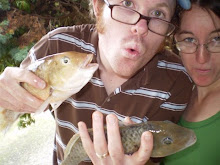
In the meantime we embarked on our dhow trip. We were joined by Captain Ali, his quiet crewmate and son Mohammed. We spent a few hours slowly meandering around the small islands heading towards the open ocean. This trip was very reminiscent of the sailing we did with Anna’s Dad just before leaving NZ. Though the wind was meager, it was nice to be out on the seas again – peacefully drifting past all the foreign owned mansions. Once we finally reached our destination we cast anchor and quickly readied our hand lines. Prawns were irresistible to the fishes below. It took a few casts for us to get a feel for it. Most of the fish were small and could steal our bait without consequence. But soon enough a bigger fish would have a go and be caught. I was the first to catch, pulling in a monstrous Yellow Snapper – at least 12 cm in length. Then experience took over, as the crew pulled in half a dozen more in, including a decently sized fish (~30 cm). Anna showed her skills pulling in two of her own Yellow Snappers. Once we had enough fish we anchored on Manda Island and Ali prepared us lunch. Anna and I took to the water and explored the patch of coral conveniently located by the boat. Although the water was murky, you could still see lots of beautiful fish when close to the rock. Anna even spotted a lobster that was holed up on the coral.
From the sea to the fire
A right feast!
Lunch was served under a banda, a welcome break from the sun. A real feast was had: BBQed fish, coconut rice, veges in coconut sauce, salad and fruit (the secret to Swahili cooking is to use coconut in everything). Once lunch had settled we pack the dhow and set sail for home. As we came up to Lamu, we had to carefully maneuver through the dhows lined up for the final dhow race of the festival. What a splendid trip.
Readying to set sail
In full control
As the evening approached, we waited for Salem at the designated spot for 20 minutes, but he was a no show. We moved on, wandering the streets and enjoying the sidewalk dancing. A few hours later we spotted and approached him. He complained that the place was to crowded to find us (two white sheep amongst a sea of black!!)….and um..he looked for us twice…um… In the end he admitted that he didn’t turn up. We demanded our money back but he said he had none on him having just bought the medicine in his hand. He still spoke of guests he had waiting for him at his house and that we could still join them for dinner. But we had had enough of this hoax.
We couldn’t do much more than wait for his promised return half an hour later. We might not get the money back but at least we would have an amusing cat and mouse game. Strangely he did return, unsurprisingly late and with yet more excuses for being without our money. Apparently his guests only had 100 Euros which they needed to change before he could pay us – Yeah Right! This time he gave us his hat and kikoi (think lavalava/kilt) as a pledge to be exchanged for our money the next morning.
Old town views from Lamu Fort
But turn up he did not. We trusting souls waited even 30 minutes, just wanting closure. After learning some more about Swahili culture in the Lamu Museum and scoping the sights of the old town from the ramparts of Lamu Fort, we headed for our last juice. Whilst sitting at Hapa Hapa, we spotted our man again – on the prowl for some new tourists. He came in and asked if we had his belongings and promised to return after he had gone to the bank with his ‘guests.’ We gave him 20 minutes to return. Whilst we finished our juice, someone came up and asked if we had been conned by the old man. Apparently he has been doing this racket for awhile. Embarrassed, we showed him the spoils we were holding ransom. He wished us best of luck in getting our money back.
The clock struck 11:40 AM and it was time to board the ferry back. Consoled that he was a con – we board the ferry with two souvenirs his green hat and well-used kikoi. Not bad for 200 Ksh.
To follow up our post on ASSETS, I thought should post a couple testimonies from students who have graduated secondary school with the help of ASSETS.
Oscar Mwaro
Born 1984
From Mijomboni
Graduated from Lenana School in 2005.
Currently in University
“…..I dropped out of school in 2002 owing to a lack of funds to pay for my school fees. I was very disappointed because I thought I was not going to be able to continue with my secondary school education. I felt my dreams were slipping away. Then along came ASSETS... Thanks to the project, I was able to finish my secondary school education last year with grade B aggregate. In January 2007, I hope to go to university to study health sciences.
I’m proud to be an ASSETS beneficiary and enjoy all the activities that we can be involved with….”
Oscar attended one of the best secondary schools in Kenya. After school he taught French in a number of private schools before Joining the University of Nairobi. Oscar is now pursuing a Bachelor of Arts degree in Environmental Studies and Geography. For his higher education, Oscar is being supported by Gift International.
Leah Mwamure
Born 1985
From Bogamachuko
Graduated from Vitengeni Baptist High School in 2005.
Graduated from Teacher Training College
“You have made me warm and God bless you all” (Leah’s comments when she was visited by ASSETS committee members on her graduation day.)
Leah is among our very first lot of students that we supported. While she was a student she was supplied with some tree seedlings to plant in her farm. Upon graduation from High School, Leah sold some of the trees and raised enough money to support her younger brother who was joining secondary school. Leah has so far qualified as a primary teacher and teaches in a private school in Malindi.